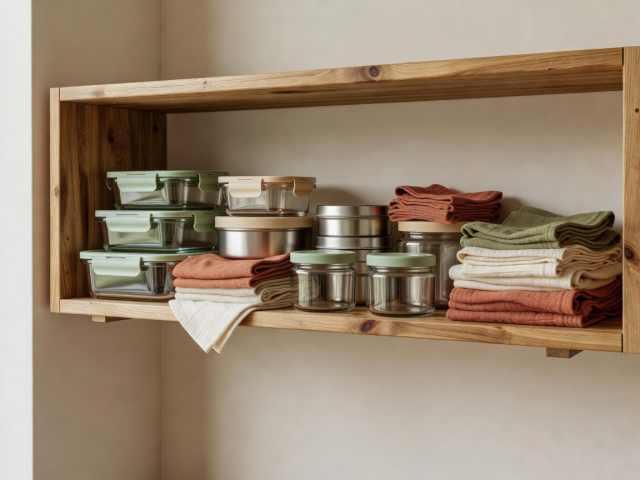
Start with one recurring task
A reusable system is more than a replacement object. It includes where the object lives, how it is used, how it becomes clean and who returns it. Choose a task that happens often enough to matter but is simple enough to understand: packing lunch, wiping a table or carrying groceries. Observe the current routine before buying anything.
Ask where the task usually breaks down. Perhaps containers are clean but their lids are missing. Perhaps bags live beside the door while shopping begins from the car. Perhaps washable cloths are available but nobody knows where used ones should go. These are placement and coordination problems. A larger collection of products rarely fixes them on its own.
Give the routine three clear places
Create a ready place near the start of the task. Keep matching parts together and make the supply visible enough to understand at a glance. Then identify the return place: a suitable laundry container, a washing-up area or a repair tray. Finally, allow space for drying or checking before an item returns to the ready place.
Keep the supply proportionate to washing frequency and storage space. Too few items can force an inconvenient extra wash; too many can hide dirty or damaged stock. Use what you already own where it is suitable. A food container must be intended for that use and temperature range; an old chemical bottle is never an acceptable substitute.
Make hygiene part of the design
Reusable does not mean indefinitely usable without care. Wash food-contact items according to their instructions, dry them appropriately and replace components that can no longer be cleaned or used safely. Keep cleaning cloths for different tasks separate where cross-contamination is a concern. A routine that leaves damp cloths piled together needs a better return and drying arrangement.
Follow food-safety guidance for storage and reheating. The UK Food Standards Agency and the U.S. Food and Drug Administration provide household information, but product instructions and local guidance still matter. Do not preserve a worn container solely to avoid waste if damage makes it unsuitable. Safety is a legitimate reason to retire an object.
Share the reset, not just the intention
In a shared household, agree on a system that someone can follow without a spoken reminder. Label a shelf if that helps, keep the return point obvious and decide when the reset happens. “Use the cloths” is incomplete if only one person notices when they need washing. Include the cleaning and restocking work in the agreement.
Design around the busiest ordinary day. If the routine only works when everyone is rested and on schedule, simplify it. Keep an appropriate fallback for illness, travel or disrupted care routines. Using a disposable item when needed does not erase the value of a reusable system that works most of the time. Avoid turning a practical change into a source of household conflict.
Approach refills with a clear boundary
Refill systems can reduce some packaging, but the details matter. Consider travel, container life, washing and whether the product will actually be used. A dedicated long trip for a small refill may not be the best routine. Combine collection with an existing journey where practical and check the retailer’s container requirements.
Keep products in compatible, clearly labelled containers and retain essential safety information. Never mix cleaning products, and never use food or drink containers for household chemicals. Do not top up an unfamiliar residue with a new formulation. Concentrates need the specified dilution and handling; making a stronger mixture is not a shortcut to better cleaning.
Repair before accumulating replacements
Set aside a small, visible place for repairable items and give it a limit. Note the fault, the part required and the next action. If an item has remained there without a realistic plan, decide whether to seek help, pass it on honestly or dispose of it through the correct route. Storage alone does not extend useful life.
A local Repair Café may offer help with suitable objects, while the iFixit guides can help explain how some products are assembled. Neither removes the need to recognise your limits. Batteries, mains electricity, pressure systems and structural components can carry serious risks. Use qualified repair services when needed, and do not defeat safety features to keep something operating.
Judge the system by repeated use
Review whether items are actually circulating, whether cleaning fits existing loads and whether the household finds the arrangement easier. Environmental results depend on material, use count, washing and the alternative being replaced, so avoid a universal break-even claim. The practical goal is to use suitable things for a long time without building an unnecessary collection.
Once one routine works, leave it alone long enough to become ordinary. Add another only when there is a clear reason and enough capacity. A modest system that survives daily life is more valuable than an impressive shelf of unused intentions.
Useful reuse and repair references
- Repair Café International — community repair information.
- iFixit — product repair resources.
- Food Standards Agency and U.S. FDA food guidance — food-safety information.
- WRAP — resource-use and waste-prevention research.